Your Space Is Talking to You
Feng Shui — aligning your environment to let the energy flow
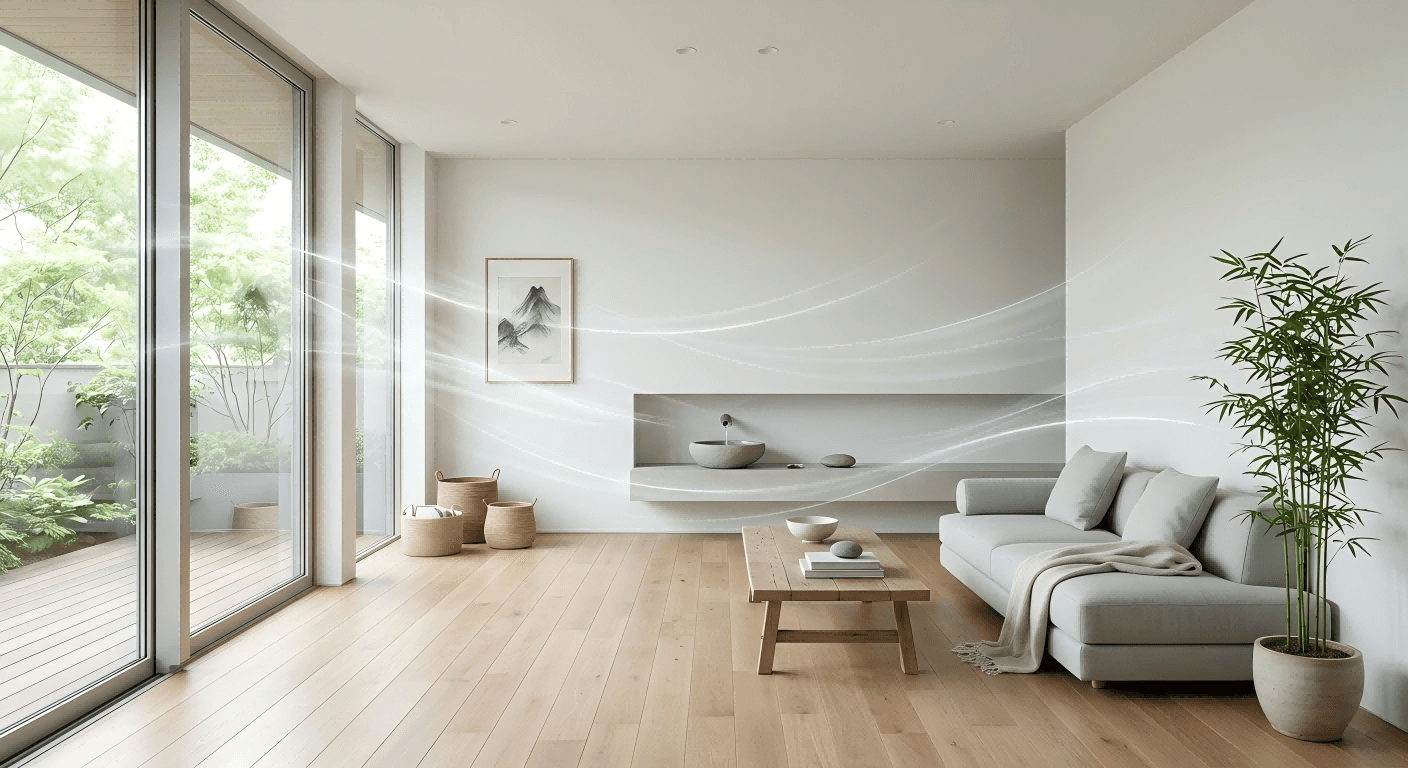
The Space That Felt Wrong, and the One That Felt Like Home
You know the feeling. You walk into a space. It could be a room, a building, a street, even a plot of land. Something in your chest tightens. You can't name what's wrong. Everything looks fine on the surface. But your body wants to leave. Your shoulders creep up toward your ears. Your breath becomes shallow. You find yourself checking your phone just to have an excuse to look away from something. You don't know what.
Then you walk into another space. Perhaps in a different house, a different neighborhood, a different city, a different country. You exhale. You didn't realize you were holding your breath until that moment. Your shoulders drop. Your mind quiets. You feel held. Safe. At ease. Again, you can't explain why. The architecture might be completely different from what you usually prefer. The style might not match your taste. But something about this space feels right, as if the space itself is welcoming you rather than merely containing you.
We've all had these experiences. Most of us dismiss them as mood, as coincidence, as some quirk of personal preference we don't need to examine too closely. We don't stop to ask: what caused this? What is this space doing that the other one wasn't? Why did my body respond before my mind had time to think?
For over three thousand years, Chinese philosophers and practitioners have been asking exactly these questions. They developed an entire system for understanding the relationship between human beings and their built environment. A system that claims your space is not just a backdrop to your life, but an active participant in shaping your thoughts, your emotions, your relationships, and even your destiny. They called it Feng Shui.
Whether you believe Feng Shui is ancient wisdom or superstition, whether you think it's a profound spiritual practice or a marketing gimmick, one thing is undeniable: you have felt what it describes. Your body knows something your mind hasn't learned to articulate. This article is an invitation to listen.
What Is Feng Shui, and What It Is Not
Feng Shui (风水,pronounced "fung shway") literally means "wind and water." At its core, it's the ancient Chinese practice of arranging your environment: your home, your office, your city, even your burial sites. The goal is to harmonize with the natural flow of energy, or Qi (气,pronounced "chee"), that moves through all things.
Think of it this way: you already understand that the arrangement of a room affects how you use it. A couch facing a blank wall invites isolation. A kitchen island creates a natural gathering point. A cluttered desk makes it harder to focus. Feng Shui takes this basic insight, that space shapes behavior, and extends it much further. It claims that the arrangement of your environment doesn't just affect what you do, but how you feel, how you think, how you relate to others, and what opportunities arise in your life.
Traditional Feng Shui is a sophisticated system that incorporates the cardinal directions (north, south, east, west), the five elements (wood, fire, earth, metal, water), the Bagua map (an eight-sided energy grid that overlays your space), the flow of Qi through doors, windows, and pathways, the balance of Yin and Yang energies, and the relationship between your space and the larger landscape: mountains, water bodies, roads, and neighboring structures.
But here's what Feng Shui is not. It's not about placing a money frog in your wealth corner and expecting a windfall. It's not about painting your front door red because "red is lucky." It's not about hanging wind chimes in every window or arranging your furniture according to Instagram aesthetics. These pop-culture versions of Feng Shui, the ones that dominate Western interior design magazines and self-help bestseller lists, are like reducing a symphony to a ringtone. They capture a fragment of the melody but miss the harmony, the structure, the depth.
Authentic Feng Shui isn't a quick fix or a superstition-based decoration scheme. It's a holistic approach to environmental design that asks: how does this space support or undermine the life you're trying to live? What energy does this room cultivate? What story is your environment telling? And is it the story you want to inhabit?
Where Feng Shui Actually Came From
Feng Shui is at least 3,000 years old. Older than Buddhism, older than Confucianism, older than most of what we think of as "ancient wisdom." Its origins stretch back to the Shang Dynasty (c. 1600-1046 BCE), when Chinese civilization was still finding its footing along the Yellow River.
But Feng Shui didn't begin as interior design. It began as survival.
Early Chinese communities were agricultural societies entirely dependent on the land. Where you settled determined whether your crops would flourish or fail. Where you buried your ancestors was believed to affect the fortune of future generations. The placement of your home in relation to wind patterns, water sources, and mountain ranges could mean the difference between prosperity and disaster, health and disease, life and death.
The earliest Feng Shui practitioners weren't decorators. They were geomancers, specialists in reading the landscape and determining the most auspicious locations for settlements, farms, temples, and tombs. They observed patterns that modern science is only beginning to validate: that certain locations have better air circulation, that water proximity affects humidity and temperature, that mountain placement influences wind patterns, that the direction your home faces affects how much sunlight you receive and how well you sleep.
Over centuries, these practical observations evolved into a sophisticated system. By the Han Dynasty (206 BCE-220 CE), Feng Shui had become a complex art incorporating astronomy, geography, mathematics, and philosophy. Imperial courts employed Feng Shui masters to advise on the placement of palaces and cities. The Forbidden City in Beijing, one of the most famous architectural achievements in human history, was designed according to Feng Shui principles, as were countless temples, homes, and ancestral halls throughout China and East Asia.
Feng Shui wasn't superstition to these ancient practitioners. It was technology. The best available science for understanding the relationship between human beings and their environment. They may have used different language than we use today, speaking of Qi and dragons rather than electromagnetic fields and air quality. But they were observing real phenomena, testing hypotheses, and refining their methods based on results.
The Taoist Roots: Qi, Flow, and the Art of Placement
Feng Shui is inseparable from Taoism. While it incorporates elements from Confucianism and Chinese folk religion, its philosophical foundation is thoroughly Taoist. To understand Feng Shui is to understand three core Taoist concepts: Qi, the balance of Yin and Yang, and the principle that the outer world reflects the inner.
The full exploration awaits.
Become a member of Tao Compass to support the work and continue your journey.