You Don't Need More Answers. You Need Better Questions
How Taoist inquiry dissolves confusion without adding more noise
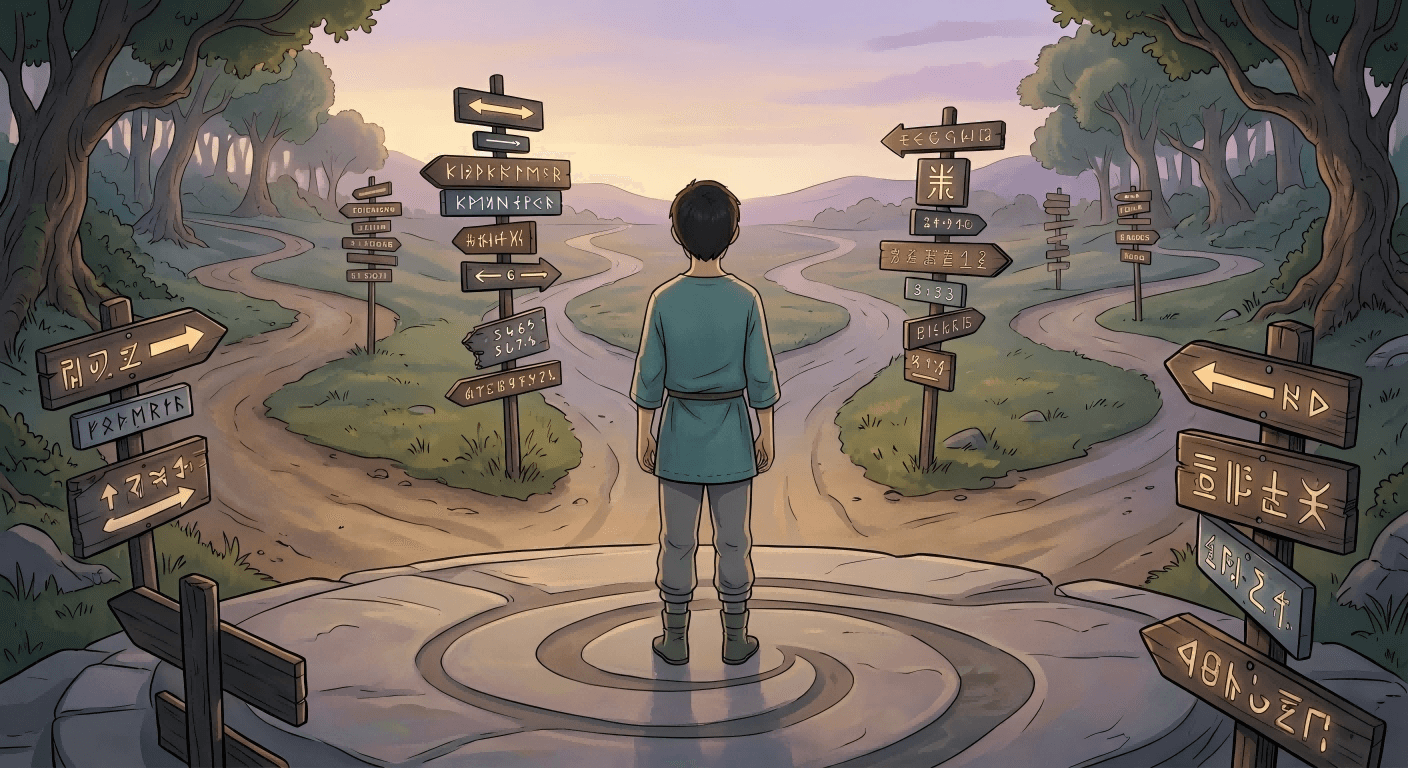
The Night You Searched for Answers and Found Only More Questions
You have opened your phone at 2am looking for clarity and closed it an hour later feeling worse. The blue light harsh against the darkness. The endless scroll. The search queries that led to articles that led to forums that led to Reddit threads that led to podcast episodes that led to YouTube videos. An hour later, your chest feels tighter than before. Your mind is louder. And you have found nothing that actually helps.
This is the familiar spiral of modern information-seeking. You are looking for an answer to a question that matters to you. Maybe it is about your health, your relationship, your career, your purpose. Maybe it is about why you feel the way you feel, why life feels the way it feels. You want clarity. You want certainty. You want someone to tell you what to do, what to think, what to believe.
But the more you search, the more contradictory the information becomes. One expert says one thing. Another says the opposite. Someone shares their experience and it resonates deeply. Someone else shares theirs and it terrifies you. By the time you close your phone, you do not have an answer. You have seventeen new questions and a peculiar exhaustion that comes from mental activity without resolution.
You were looking for certainty. You found complexity. You were looking for peace. You found more noise.
This is not a failure on your part. This is what happens when you ask the internet to do what only stillness can do.
Why We Are Addicted to Answers
Certainty feels safe. Uncertainty feels like a threat. This is not a preference. This is biology.
Your nervous system is designed to detect patterns, predict outcomes, and resolve ambiguity. When you encounter something unknown, your brain registers it as a potential threat. Not necessarily a life-threatening danger, but a disruption to your sense of order, your ability to navigate the world with confidence.
An answer, any answer, provides relief. The question is resolved. The uncertainty is closed. You can move on. This is why the human mind craves resolution so deeply. It is not intellectual curiosity driving you. It is the desire to return to a state of equilibrium, to stop the subtle anxiety that lives inside not knowing.
But here is what happens when that craving goes unchecked. When the desire for answers becomes stronger than the desire for truth. When you would rather have a wrong answer than live with the question.
You grasp at the first explanation that feels plausible. You commit to beliefs before you have understood the complexity. You choose sides in debates you do not fully grasp. You adopt frameworks that give you the feeling of understanding without the substance.
The craving for certainty, left unexamined, becomes its own form of suffering. Because life is uncertain. Because the questions that matter most do not have clean answers. Because the mind that demands resolution will spend its life closing questions that were meant to be lived.
The Problem With Certainty
The most dangerous thing about a wrong answer is how much it resembles a right one. It feels the same. It provides the same relief. It offers the same sense of closure. But it leads you in the wrong direction, quietly, confidently, without any signal that you have gone astray.
When you close a question too quickly, you lose something essential. You lose the nuance that only emerges through sustained inquiry. You lose the growth that comes from wrestling with complexity. You lose the deeper truth that cannot be grasped by a mind rushing toward resolution.
Socrates, the ancient Greek philosopher, understood this profoundly. He wandered the streets of Athens asking questions, not providing answers. He challenged the certainty of politicians, poets, craftsmen, and religious leaders. And when his followers asked him what wisdom he had attained through all this questioning, he gave one of the most famous responses in the history of thought: "All I know is that I know nothing."
This was not false humility. This was not a clever paradox. This was the honest recognition of a mind that had seen enough to understand how much it had not seen. Socrates understood that certainty is often the enemy of understanding. That the person who thinks they know has stopped learning. That wisdom begins not with answers, but with the clear-eyed acknowledgment of your own ignorance.
The person who knows nothing but believes they know everything is closed. The person who knows they know nothing is open. And in that openness, everything becomes possible.
How Taoism Thinks About Knowing
Taoism has a quietly radical relationship with knowledge. Not anti-knowledge, not ignorant, but deeply discerning about what kind of knowing actually matters.
The full exploration awaits.
Become a member of Tao Compass to support the work and continue your journey.