The Ancient Philosophy That Was Never Meant to Be Explained
Tao — The Way That Cannot Be Named
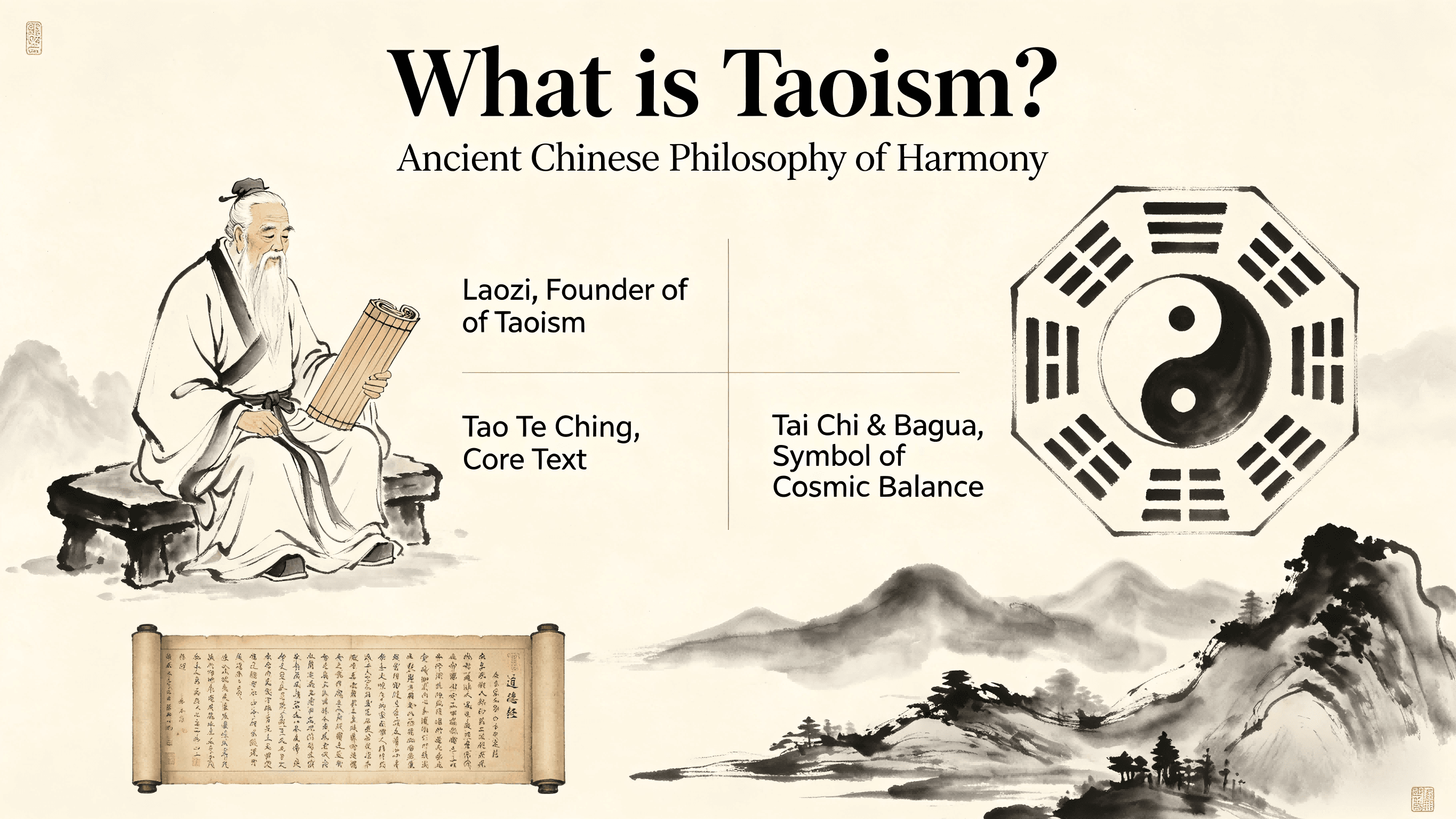
Introduction
Welcome to the path of Taoism. If you're reading this, you may have encountered a Taoist quote that resonated deeply, or perhaps you're sensing that there's a different way to approach life, one that doesn't require constant striving, control, or achievement. This article is designed as a gentle, accessible introduction for those completely new to Taoism, offering a gateway into one of the world's oldest and most profound wisdom traditions.
Taoism emerged in ancient China over 2,500 years ago, yet its insights remain remarkably relevant to our modern lives. In a world that constantly demands more, more productivity, more success, more control, Taoism offers a radical alternative: the art of effortless action, the wisdom of yielding, and the peace that comes from aligning with the natural flow of existence.
Unlike Western philosophies that emphasize logic, analysis, and control over nature, Taoism invites us to observe, accept, and harmonize with life as it actually is, not as we wish it to be. This doesn't mean passivity or resignation; rather, it means learning to move with the current rather than against it, like a skilled swimmer who works with the water rather than fighting it.
What is Tao?
The Tao (道,pronounced "dow") is the central concept in Taoism, yet it defies simple definition. The word itself means "way," "path," or "principle," but these translations barely capture its depth. The Tao is the underlying order of the universe, the invisible force that shapes all existence, the pattern that connects all things, and the continuous process of change that defines life itself.
Think of the Tao as the operating system of reality. Just as your computer runs on code that you can't see but that governs everything it does, the universe operates according to principles that are elegant, consistent, and largely invisible to our ordinary perception. The Tao is not a god to be worshipped or a set of commandments to be obeyed. It simply is, the silent, effortless force that moves through all things, from the smallest subatomic particle to the vast spiraling galaxies.
The Tao is both immanent (present in everything around you) and transcendent (beyond complete human comprehension). You can experience it in the rhythm of your breath, the changing of seasons, the growth of a plant toward sunlight, or the way water naturally flows downhill. Yet no matter how much we study or contemplate it, the Tao remains ultimately mysterious, like trying to see your own eyes without a mirror.
As the Tao Te Ching opens: "The Tao that can be told is not the eternal Tao." This isn't meant to frustrate you, but to point you toward direct experience rather than intellectual understanding. The Tao is not something to be grasped by the mind, but something to be lived and embodied.
Philosophical Taoism vs. Religious Taoism
When Westerners encounter Taoism, confusion often arises because there are two distinct but related traditions: philosophical Taoism and religious Taoism. Understanding this distinction is crucial for navigating the vast landscape of Taoist thought and practice.
Philosophical Taoism is what most Westerners encounter first. It's a way of thinking about existence, a practical philosophy for living with wisdom, ease, and harmony. Rooted primarily in the teachings of Laozi and Zhuangzi, philosophical Taoism emphasizes simplicity, spontaneity, humility, and alignment with the natural order. It doesn't require belief in deities, adherence to rituals, or membership in any organization. You can practice philosophical Taoism while being Christian, Jewish, Muslim, Buddhist, or secular, it's more about perspective and approach to life than about faith or doctrine.
Religious Taoism, by contrast, developed over centuries as an organized religion with its own priesthood, temples, rituals, and pantheon of deities and immortals. Religious Taoism incorporates practices like meditation, breathwork (qigong), alchemy, feng shui, divination, and ceremonies to honor various gods and spirits. It offers specific techniques for longevity, healing, and even spiritual immortality. Religious Taoism is primarily found in Chinese and East Asian cultures, though it has begun spreading to the West in recent decades.
It's important to understand that religious Taoism has virtually nothing to do with Laozi himself. The religion emerged several hundred years after Laozi's time, as people built upon his name and wisdom and created a structured belief system with rituals, deities, and institutional practices. This development was not Laozi's intention, and the resulting religious tradition differs significantly from his original teachings. While Laozi emphasized simplicity, spontaneity, and alignment with the natural Tao, religious Taoism evolved into a complex system with its own agenda, focused on longevity, spiritual immortality, and appeasing various gods and spirits.
Tao Compass focuses primarily on philosophical Taoism, the universal wisdom that can be applied by anyone, anywhere, regardless of cultural background or religious belief. While we occasionally touch upon religious Taoist practices and their historical significance, our main emphasis is on the philosophical teachings that offer practical guidance for modern living. However, it's worth acknowledging that religious Taoism has preserved and transmitted Taoist teachings for over two thousand years, and many of its practices (like tai chi and qigong) have become popular worldwide for their health and meditative benefits.
Laozi: The Legendary Founder
Laozi (meaning "Old Master" or "Old Sage"), also spelt as Lao Tzu, is traditionally regarded as the founder of Taoism and the author of the Tao Te Ching. According to traditional accounts, Laozi lived in the 6th century BCE, making him a contemporary of Confucius. He supposedly worked as a keeper of archives in the imperial court, a librarian or historian who had access to the wisdom of ages. Disillusioned by the moral decay, political corruption, and endless warfare of his time, he decided to leave civilization behind and live as a hermit in the mountains.
As the story goes, when Laozi reached the western border, a gatekeeper named Yin Xi recognized him as a sage and begged him to record his wisdom before disappearing into the wilderness. Reluctantly, Laozi composed the Tao Te Ching, a mere 5,000 Chinese characters divided into 81 brief verses, then continued his journey, never to be seen again.
Although the Tao Te Ching was the only work Laozi left behind, his teachings have profoundly influenced Chinese culture, philosophy, art, medicine, and spirituality for over two millennia. The Tao Te Ching has become one of the most translated books in world literature, second only to the Bible in the number of languages it's available in. Its verses have guided emperors and poets, warriors and monks, entrepreneurs and artists, anyone seeking a deeper understanding of how to live with wisdom and grace in an uncertain world.
Essential Taoist Texts
Tao Te Ching (Dao De Jing)
The Tao Te Ching is the foundational text of Taoism and one of the most profound spiritual works ever created. At only about 5,000 Chinese characters, it's remarkably brief, yet its density of wisdom means you could spend a lifetime studying it and still discover new insights.
The title itself reveals its structure: "Tao" means "the Way" or "the Path"; "Te" means "virtue" or "power", the natural excellence that comes from aligning with the Tao; and "Ching" means "classic" or "scripture," indicating a text of enduring wisdom and authority. Together, "Tao Te Ching" can be understood as "The Classic of the Way and Its Power."
This is the only book Laozi ever wrote, yet it has become one of the most translated books in world literature, second only to the Bible. Its profound influence has spread across cultures and centuries, continuing to inspire readers worldwide.
The text is divided into two parts: the Tao Ching (chapters 1-37) explores the nature of the Tao itself, while the Te Ching (chapters 38-81) discusses how to embody the Tao through virtuous living. The verses are poetic, paradoxical, and deliberately open to interpretation, designed to be contemplated rather than analyzed, to open your intuition rather than satisfy your intellect.
Key themes include: the ineffability of the Tao, the value of humility and simplicity, the practice of wu wei (effortless action), the dangers of excessive desire and ambition, the wisdom of yielding like water, and the qualities of the sage who lives in harmony with the Tao. There are countless translations available, each offering a different flavor, some more literal, some more interpretive. Reading multiple translations can give you a richer understanding of this timeless text.
Zhuangzi (Master Zhuang)
If the Tao Te Ching is the heart of Taoism, the Zhuangzi is its imagination. Written by Zhuang Zhou (c. 369-286 BCE), this text expands and enlivens Taoist philosophy through stories, parables, dialogues, and thought experiments that are playful, provocative, and deeply insightful.
Zhuangzi is famous for his humor and irreverence. He mocks conventional wisdom, punctures philosophical pretensions, and uses absurdity to shake readers out of rigid thinking. His most famous story tells of dreaming he was a butterfly, and upon waking, wondering whether he was Zhuangzi who had dreamed of being a butterfly, or a butterfly now dreaming of being Zhuangzi. This paradox illustrates the Taoist insight that our ordinary distinctions (self/other, dream/reality, life/death) may not be as solid as we assume.
The Zhuangzi emphasizes freedom, spontaneity, and the relativity of all perspectives. It teaches us to flow with change, to find joy in simplicity, and to recognize that what we call "useless" may actually be most valuable. Unlike the austere Tao Te Ching, the Zhuangzi is exuberant and entertaining, yet no less profound in its wisdom.
I Ching (The Book of Changes)
The I Ching is one of the oldest Chinese classics, predating Taoism itself but deeply integrated into Taoist thought. It's an oracle, a divination system based on 64 hexagrams (patterns of six lines, either broken or unbroken) that represent different archetypal situations and states of change.
While the I Ching is often associated with divination, fortune-telling represents only a tiny fraction of its true value. The I Ching's wisdom is unparalleled, a sophisticated cosmology that maps the dynamic interplay of yin and yang, the complementary forces that drive all transformation. As Confucius noted, "Those who truly understand the I Ching do not use it for divination", recognizing that its profound insights far exceed mere fortune-telling.
The I Ching teaches that change is the only constant in the universe, and that wisdom lies in recognizing the patterns of change and aligning with them. Each hexagram offers guidance about how to navigate specific circumstances: when to advance, when to retreat, when to persist, when to yield. Confucius reportedly said that if he could live fifty years longer, he would devote them to studying the I Ching, and he might have mastered it. Like the Tao Te Ching, it's a book you return to throughout your life, each time finding new relevance as your circumstances evolve.
Core Taoist Concepts
Tao (道,The Way)
As discussed above, the Tao is the fundamental principle underlying all existence. It's the source from which everything arises and the destination toward which everything returns. The Tao is not static but dynamic, not a fixed object but an ongoing process. Think of it less as a "thing" and more as a "way", the unfolding of reality itself, the continuous creative activity that generates and sustains all beings.
Te (Virtue/Power)
Te is often translated as "virtue," but not in the moralistic Western sense of being "good" or "righteous." Rather, Te is the natural excellence or power that emerges when you align with the Tao. It's the authentic expression of your true nature, unforced and unpretentious.
Think of Te as the fragrance of a flower, it doesn't try to be fragrant; it simply is, by being fully itself. A person with Te doesn't try to be virtuous; they naturally act with wisdom, compassion, and effectiveness because they're in harmony with the Tao. Te is cultivated not through effort or willpower, but through letting go of artificiality and returning to simplicity.
Yin and Yang
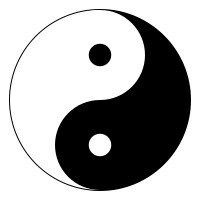
Yin and yang are the two complementary, interdependent forces that constitute all phenomena. Yin is receptive, yielding, dark, cool, feminine, introspective, and associated with earth, moon, and night. Yang is active, assertive, bright, warm, masculine, expressive, and associated with heaven, sun, and day.
Crucially, yin and yang are not opposites in conflict, they're partners in a cosmic dance. Each contains the seed of the other (shown by the small dots in the familiar taijitu symbol), and each transforms into the other in an endless cycle. Day becomes night, activity gives way to rest, birth leads to death which leads to rebirth.
Taoism teaches that health and harmony come from balancing yin and yang within ourselves and in our lives. Too much yang leads to burnout, aggression, and exhaustion; too much yin leads to stagnation, depression, and inertia. The wise person knows when to act (yang) and when to rest (yin), when to speak and when to listen, when to lead and when to follow.
Wu Wei (Effortless Action)
Wu wei is perhaps the most misunderstood Taoist concept. Literally meaning "non-action" or "without action," it doesn't mean laziness, passivity, or doing nothing. Rather, wu wei is action that is so perfectly aligned with the Tao that it feels effortless, like a dancer moving with the music, a surfer riding a wave, or a gardener working with the seasons.
Wu wei is the opposite of forced, strained, or artificial effort. It's acting without excessive striving, without ego-driven attachment to outcomes, without fighting against reality. When you practice wu wei, you don't push the river, you learn its current and flow with it. You don't force solutions; you allow them to emerge naturally.
Think of the difference between swimming upstream (constant struggle, exhausting progress) and floating downstream (effortless movement, natural alignment). Wu wei doesn't mean you never take action; it means your actions arise from clarity and harmony rather than from fear, desire, or resistance. It's the art of doing less while accomplishing more.
Ziran (Naturalness/Spontaneity)
Ziran literally means "self-so" or "what is naturally so." It refers to the state of being genuine, spontaneous, and true to one's nature without artificiality, pretense, or external compulsion. A tree growing toward sunlight is ziran; a river flowing downhill is ziran; a child playing with complete absorption is ziran.
For humans, ziran means living authentically, not according to society's expectations, not according to rigid rules or roles, but according to your own deepest nature. It doesn't mean indulging every impulse; it means discerning what is genuinely you versus what has been imposed upon you by culture, family, or conditioning.
Ziran is closely related to simplicity (pu, the "uncarved block"). When you strip away pretense, affectation, and unnecessary complexity, what remains is ziran, your natural state, spontaneous and true.
Pu (The Uncarved Block)
Pu symbolizes the original, natural state of things before they're shaped by human intervention or artificial refinement. An uncarved block of wood contains infinite possibilities; once carved, it becomes limited to one specific form. Similarly, the human mind in its natural state is open, flexible, and receptive; once filled with fixed ideas and judgments, it loses its adaptability.
Taoism encourages us to return to pu, to cultivate simplicity, humility, and openness. This doesn't mean becoming ignorant or uneducated; it means maintaining a beginner's mind, free from arrogance and preconception. The sage is like an uncarved block: simple on the surface, yet containing unlimited potential.
Nine Taoist Practices for Daily Life
Taoism is not merely a philosophy to be studied, it's a way of life to be practiced. The following nine practices offer practical ways to cultivate Taoist wisdom in your everyday experience. You don't need to master all of them at once; simply choose one or two that resonate with you and begin there. Like water shaping itself to the terrain, let your practice evolve naturally.
1. Nonaction (Wu Wei)
Nonaction doesn't mean doing nothing, it means acting without forcing outcomes. It's responding to situations with minimal contrivance, allowing things to unfold naturally in accordance with the Tao. Like a skilled sailor who works with the wind rather than against it, nonaction is the art of effortless effectiveness.
In practice: Before taking action, pause and sense the natural flow of the situation. Ask yourself: "Am I forcing this, or allowing it?" Act when action is needed, but let your actions arise from clarity and alignment rather than from panic, ego, or the need to control. The result is action that feels effortless and produces results without unnecessary struggle.
2. Softness and Weakness
Taoism values flexibility, humility, and yielding strength, qualities often misunderstood as weakness. Consider water: it's soft and yielding, yet it can wear down the hardest rock over time. Water doesn't resist obstacles head-on; it flows around them, finding the path of least resistance.
In practice: When you encounter resistance, notice your instinct to push harder. Instead, try yielding. Be like bamboo in the wind, flexible enough to bend without breaking. Softness isn't weakness; it's a different kind of strength, one that endures because it doesn't fight against what is.
3. Guarding the Feminine
"Holding to the receptive" means maintaining a quiet, nurturing, non-dominating posture that preserves inner vitality and avoids aggressive display. In Taoist cosmology, the feminine represents receptivity, intuition, and the capacity to receive and nurture life.
In practice: Cultivate receptivity in your interactions. Listen more than you speak. Create space for others to express themselves. Notice when you're in "conquering mode", trying to dominate, control, or prove yourself, and consciously soften. This doesn't mean being passive; it means leading through support rather than force.
4. Being Nameless
Being nameless means not fixating on labels, status, or reputations. It's returning to the simplicity that exists before concepts and distinctions arise, the state of being without the need to define, categorize, or justify yourself.
In practice: Notice how often you're concerned with how others perceive you, or how you label yourself (successful, failed, smart, inadequate). Practice letting go of these labels. Who are you without your job title, your achievements, your failures? Rest in the nameless awareness that exists prior to all concepts. This is freedom.
5. Clarity and Stillness
Clarity and stillness refer to cultivating mental and energetic quiet so that perception becomes clear and you can align with the natural order without agitation. A muddy pond cannot reflect the moon; an agitated mind cannot perceive reality clearly.
In practice: Create daily moments of stillness, sitting quietly, walking in nature, or simply pausing between activities. When your mind is racing, don't try to stop thoughts by force. Instead, observe them without attachment, like clouds passing through the sky. Gradually, the mind settles on its own, and clarity emerges naturally.
6. Being Adept
Being adept means developing broad skill in "the goods", virtues and beneficial actions, so that your conduct is reliably helpful, timely, and appropriate. It's not about technical proficiency but about cultivating wisdom in how you engage with the world.
In practice: Reflect on your actions throughout the day. Are they beneficial or harmful? Timely or premature? Appropriate to the situation or driven by habit? Cultivate awareness of the impact of your words and deeds. Being adept isn't about perfection; it's about continuously refining your ability to respond skillfully to life's circumstances.
7. Being Desireless
Being desireless doesn't mean having no desires at all; it means reducing the grasping and craving that distort judgment. When you're driven by compulsive desires, you lose touch with what's actually fitting and instead chase what the ego wants.
In practice: Notice the difference between natural desires (hunger, rest, connection) and compulsive cravings (the need for more, better, different). When desire arises, pause and ask: "Is this a genuine need, or am I trying to fill an inner void with outer satisfaction?" Being desireless is finding contentment in what is, rather than constantly chasing what isn't.
8. Knowing How to Stop and Be Content
Knowing how to stop and be content means recognizing sufficiency, setting limits and resting satisfied so that ambition doesn't become compulsive and destructive. It's understanding that more is not always better, and that true richness comes from appreciating what you have.
In practice: Before pursuing more, more money, more success, more possessions, pause and ask: "Do I have enough?" Notice the mind's tendency to always want something different, something more. Practice gratitude for what's already present. Knowing when to stop isn't settling for less; it's recognizing that you already have what matters.
9. Yielding and Withdrawing
Yielding and withdrawing means stepping back, giving way, and letting others take precedence when appropriate. It's the wisdom of reducing conflict and maintaining harmony by not always insisting on having your way or being in the spotlight.
In practice: Notice when you're pushing forward, insisting on your approach, or needing to be central. Practice stepping back. Let someone else lead. Allow others to have their moment. Yielding doesn't mean abandoning your principles; it means choosing harmony over being right, collaboration over competition. Often, by withdrawing, you create space for something better to emerge.
Begin Your Taoist Journey
Taoism is not a philosophy to be understood intellectually, but a way of life to be embodied. You don't "master" Taoism the way you might master a subject in school; you grow into it, like a tree growing toward sunlight, gradually, naturally, without force.
As you continue exploring Taoism, remember these key points: First, the Tao cannot be fully captured in words, these teachings are fingers pointing at the moon, not the moon itself. Direct experience is your ultimate teacher. Second, Taoism is practical wisdom, not abstract theory. The value of these teachings lies not in how well you understand them but in how you live them. Third, there's no rush. Taoism teaches the wisdom of natural timing. Let your understanding deepen at its own pace.
Laozi wrote: "A journey of a thousand miles begins with a single step." You've already taken that step by reading this far. The path of Taoism unfolds before you, not as a straight line to a destination, but as a spiral deepening into the mystery of existence itself.
As you move forward, carry this essential insight: The Tao is not somewhere else, in some future moment when conditions are perfect. The Tao is here, now, in this breath, in this moment, in this ordinary, miraculous life you're living. You don't need to attain anything special; you need only to awaken to what's already present.
May your journey be gentle, your steps be light, and your heart be open to the endless mystery of the Way.