You're Not Burned Out. You're Fighting the River
Wu Wei — Effortless Action
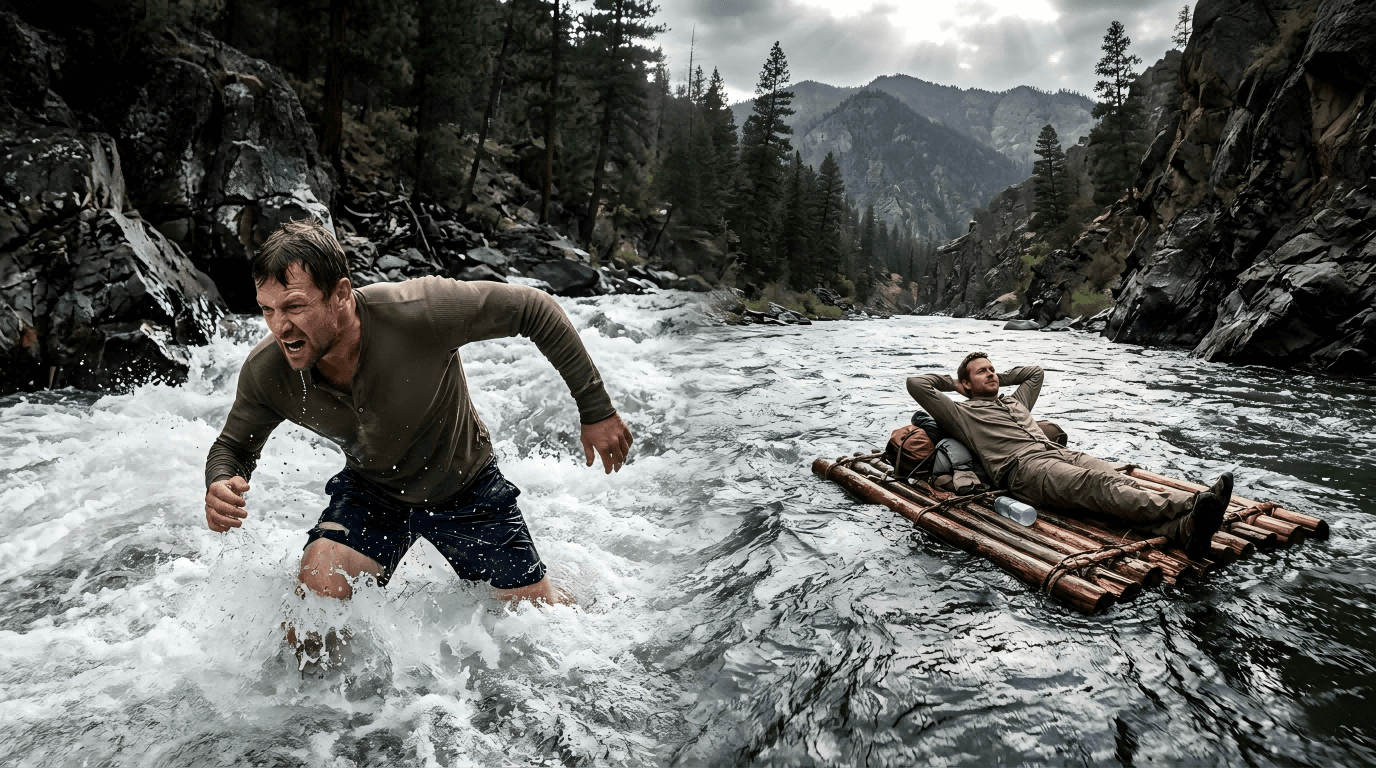
The Moment You Recognize Yourself
It's Sunday night at 11:47 PM. Your laptop is open on the kitchen table, the blue light harsh against the darkness. The cursor blinks in your document, mocking you. Tomorrow morning you have a presentation you haven't finished, three meetings you're not prepared for, and an inbox with 247 unread messages that somehow multiplied while you weren't looking. Your chest feels tight, like there's a weight sitting on your sternum. Your shoulders have crept up toward your ears, and when you consciously drop them, they immediately climb back up. You're running on coffee, adrenaline, and something that feels like desperation.
You think about Monday morning, how you'll drag yourself out of bed at 6:30 AM, how you'll push through the day on sheer will and whatever caffeine you can metabolize, how you'll collapse into bed Monday night only to do it all again Tuesday, Wednesday, Thursday, Friday. And maybe Saturday too, because there's always something. And you wonder, not for the first time: Is this what life is supposed to feel like? This constant exhaustion, this endless striving, this sense that you're running as fast as you can but somehow not getting anywhere? You look around and everyone else seems to be managing just fine, posting their achievements on social media, talking about their side hustles, wearing their exhaustion like a badge of honor. So maybe the problem is you. Maybe you're just not working hard enough.
Here's what nobody told you, what nobody ever says out loud: the struggle was never the point. The exhaustion was never the goal. The friction you feel isn't proof that you're growing, it's a signal that something is fundamentally misaligned. You weren't meant to live like this. Not because you're special or entitled, but because no human being was designed to operate in permanent resistance against their own nature. The fact that you're exhausted doesn't mean you're failing. It means you're fighting the river.
The Lie We Were All Told
Most of us grew up absorbing a story so deeply that we stopped noticing it was a story. The story goes like this: if you want to succeed, you have to work hard. Really hard. The harder you work, the more you'll achieve. Rest is for the weak. Struggle is the price of progress. If you're not exhausted, you're not trying hard enough. You heard it from your parents, your teachers, your coaches, your bosses. You saw it in movies, in biographies of successful people, in the way society celebrates the self-made individual who sacrificed everything to make it.
This story didn't come from nowhere. It's woven into the fabric of Western culture, the Protestant work ethic that equated hard work with moral virtue, the industrial revolution that turned human beings into cogs in machines, the capitalist imperative that measures worth in productivity, the self-made myth that glorifies individual hustle while ignoring systemic advantages. We're raised to believe that effort equals value, that discomfort proves you're growing, that pushing through resistance is the only path to success. We celebrate the grind, romanticize the hustle, and treat burnout as a rite of passage.
And here's the thing: this story isn't entirely wrong. Effort matters. Persistence matters. Discipline matters. There are times when you need to push through discomfort, when you need to do things that don't come naturally, when you need to persist even when it's hard. But somewhere along the way, we confused effort with suffering. We started believing that if something feels easy, it must not be valuable. If you're not struggling, you must not be trying hard enough. We prioritized Yang, action, light, noise, doing, achievement, over Yin, rest, darkness, stillness, being, receptivity. We forgot that they're complementary forces, not opposing ones.
The result? We're exhausted. Not just physically, but spiritually. We're swimming upstream so hard that we've forgotten there's another way to move through water. We've become so identified with struggle that we don't recognize alignment when it's available. We push when we could flow. We force when we could allow. We fight the river, and then we wonder why we're so tired.
Enter the River
But think back. There have been moments, maybe many moments, maybe more than you remember, when life didn't feel like this. Times when work flowed through you effortlessly, when you lost track of time because you were so absorbed in what you were doing. When a conversation unfolded perfectly without you planning it, when the right words came at the right time, when you felt connected to something larger than yourself. When you woke up energized, moved through your day with clarity, and fell into bed satisfied rather than depleted.
Maybe it was a morning when everything aligned, the train arrived on time, your ideas came easily, your colleagues were collaborative and kind, and by the end of the day you'd accomplished more than usual but felt less tired. Maybe it was a creative project that seemed to write itself, or paint itself, or code itself, as if the work was moving through you rather than being forced out of you. Maybe it was a difficult conversation that resolved naturally because you stopped trying to control it, stopped rehearsing your responses, and simply listened. Maybe it was a relationship that felt easy, where you didn't have to perform or prove or pretend.
These moments weren't accidents. They weren't luck. They weren't anomalies in an otherwise difficult life. They were glimpses of Wu Wei (无为), the Taoist principle of effortless action. Wu Wei isn't some exotic Eastern philosophy you need to study for years to understand. It's not reserved for monks on mountaintops or sages in ancient texts. It's a quality you've already experienced and simply forgotten. It's the feeling of being in the right place at the right time, doing the right thing, with a sense of ease that feels almost miraculous. Athletes call it "the zone." Artists call it "flow." Psychologists call it "optimal experience." Laozi called it Wu Wei.
The question isn't whether you're capable of Wu Wei. You already are. The question is: where in your life are you rowing so hard that you've stopped noticing the current? Where have you become so identified with struggle that you can't recognize ease? Where are you fighting the river when the river wants to carry you?
What Laozi Actually Said
Over 2,500 years ago, Laozi wrote the Tao Te Ching, a short book of 81 verses that contains some of the most profound wisdom ever written. At only 5,000 Chinese characters, it's remarkably brief, yet its density of wisdom means you could spend a lifetime studying it and still discover new insights. And at its heart is this radical idea: the way to accomplish more is to do less. Not less action, but less forcing. Less striving. Less resistance against the natural flow of things.
The full exploration awaits.
Become a member of Tao Compass to support the work and continue your journey.