Chaos Isn't the Opposite of Peace. It's the Path To It
Mastering the flow of Yin and Yang — embrace contradiction to navigate uncertain times

The Year Everything Fell Apart, and What Came After
Most people have a year they would rather forget. The year the relationship ended without warning. The year the job disappeared, the health failed, the ground you thought was solid turned out to be sand. You had plans. You had certainty. You had a vision of how things were supposed to go. And then life had other ideas.
You remember the feeling. Not just the pain, but the confusion. The sense that something had gone wrong, that this was not how it was supposed to be. You looked at other people, the ones whose lives still made sense, and you wondered what you had done to deserve this chaos.
But here is what you also remember, if you are honest. You remember the quiet moment that came after the storm. Not immediately. Not while you were still in the thick of it. But later, when the dust had settled enough to see clearly. You remember noticing something you had not seen before. A strength you did not know you had. A clarity that only comes when everything else has been stripped away. A sense that maybe, just maybe, the collapse was not the end of your life but the beginning of a different one.
This is not a platitude. This is not toxic positivity dressed up as wisdom. This is the pattern of existence itself. Chaos arrives. You survive it. And something grows in the space it left behind.
Why We Treat Chaos as the Enemy
We were taught that a good life is a stable one. From childhood, you were rewarded for consistency, for predictability, for following the plan. You were praised for knowing what you wanted, for having a five-year plan, for staying the course. Uncertainty was framed as a problem to be solved, disorder as a sign that something had gone wrong.
Schools taught you to value neatness over exploration. Grades went to the students who followed instructions, not the ones who wandered into unexpected territory. Workplaces promoted the employees who could be counted on, not the ones who disrupted the system. Relationships rewarded the partners who never rocked the boat, never asked difficult questions, never demanded change.
We built entire industries around the promise of stability. Insurance, retirement planning, career counseling, self-help. All of it selling the same message: if you do it right, if you plan well enough, if you work hard enough, you can avoid the chaos. You can make your life predictable. You can control the outcome.
But life refuses to cooperate. People get sick. Companies collapse. Relationships end. Plans fail. And when they do, we do not see it as natural. We see it as failure. As punishment. As evidence that we did something wrong.
The cost of this belief is exhaustion. The constant effort to keep everything still, to prevent change, to maintain control. The anxiety that comes from knowing, deep down, that control is an illusion. The shame that arrives when life inevitably refuses to conform to your plans.
What if chaos is not your enemy? What if it never was?
The Ancient Symbol Everyone Recognises and Almost Nobody Understands
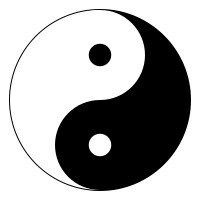
The ancient symbol of Yin and Yang
The Yin Yang symbol is everywhere. T-shirts, tattoos, coffee mugs, yoga studios, corporate logos. It has become so familiar that we barely see it anymore. We recognize it as a symbol of balance, of harmony, of Eastern wisdom reduced to a graphic.
But look at it closely. Really look at it. What do you see?
You see black and white, yes. But they are not separated by a straight line. They curve around each other, flowing, moving, inseparable. You see a dot of white in the black, a dot of black in the white. Not accident. Not decoration. The point is everything.
This is not balance as a static state. This is balance as a constant, living movement. The symbol does not depict two opposites frozen in opposition. It depicts two forces in eternal dance, each containing the seed of the other, each giving rise to the other, each meaningless without the other.
The Yin Yang symbol is not a picture of harmony achieved. It is a picture of harmony as process. As motion. As the endless turning of the wheel that brings day into night, summer into winter, life into death, death into life.
We wear the symbol without understanding it. We seek the balance it depicts without realizing that balance is not a destination. It is a movement. It is the willingness to flow with the turning, not to stop it.
What Yin and Yang Actually Mean
Yin and Yang are not good and evil. They are not male and female in any simple sense. They are not light and dark in opposition. They are complementary forces, two aspects of a single reality, each defining and giving rise to the other.
The full exploration awaits.
Become a member of Tao Compass to support the work and continue your journey.